cuba
Fidel on Trujillo; honesty in journalism; and the release of Ingrid Betancourt
The true story and the challenge of the Cuban journalists
* * *
Excerpt: ``Out of a basically humanist sentiment, we rejoiced at the news that Ingrid Betancourt, three US citizens and other captives had been released. The civilians should have never been kidnapped, nor should they have been kept prisoners in the conditions of the jungle. These were objectively cruel actions. No revolutionary purpose could justify it. The time will come when the subjective factors should be analysed in depth.''
* * *
By Fidel Castro Ruz
July 3, 2008 -- Seven days ago I wrote about one of the great men in history: Salvador Allende, a man the world remembered with deep emotion and respect on his first centennial. However, no one quivered or even recalled the date of October 24, 1891, when the Dominica Republic's despot Rafael Leonidas Trujillo was born, eighteen years before our admired Chilean brother.
`Is Cuba done with equality?' NOT!
By Fred Feldman
June 28, 2008 -- I am responding to ``Of Pay and Productivity: Is Cuba Done With
Equality?'', an article by Moshe Adler, director of Public Interest
Economics, which appeared in the June 20 Counterpunch (a radical monthly print
and daily webzine based in the US.) The article deals with the latest
modifications of the country's wage structure made public June 11.
Characteristics of the experiences underway in Venezuela, Ecuador and Bolivia
June 27, 2008 -- In Latin America, if we exclude Cuba, we can point to three general categories of governments. First, the governments of the right, the allies of Washington, that play an active role in the region and occupy a strategic position: these are the governments of Álvaro Uribe in Colombia, Alan García in Peru and Felipe Calderón in México.
Second, we find supposed “left” governments that implement a neoliberal policy and support the national or regional bourgeoisies in their projects: Brazil, Uruguay, Chile, Nicaragua and the government of Cristina Fernandez Kirchner, from Argentina’s Peronists. They are governments that implement a neoliberal policy that favour grand capital, covered up with some social assistance measures. In effect, they make it a bit easier to swallow the neoliberal pill by applying social programs. For example, in Brazil poor families receive a bit of help from the government, which assures them popular support in the poorest region of the country.
XIV Sao Paulo Forum: Left parties debate the current historic conjuncture
By Inés Hayes, with reports from Montevideo by Cristina Camusso and Julio Louis.
Dilemma: From May 22 to 25, the XIV Sao Paulo Forum was held in Montevideo, Uruguay. Under the banner `The Latin American and Caribbean left in the new time, richness in diversity’, 844 delegates from 35 countries in Latin America, Asia and Europe participated in this historic meeting. The first encounter was held in Sao Paulo, Brazil, in 1990. The debates over the crucial issues of the 21st century are embodied today in the governments which have emerged through the electoral road. The historic dilemma of reform or revolution once again returns to centre stage.
Cuito Cuanavale: How Cuba fought for Africa’s freedom
By Barry Healy
June 14, 2008 -- This year marks the 20th anniversary of the Battle of Cuito Cuanavale, a heroic struggle in which, between October 1987 and June 1988, in some of the fiercest fighting in Africa since the Second World War, the South African Defence Force (SADF) were humiliatingly defeated by liberation forces in Angola.
Cuban assistance to Angolan resistance to the SADF invasion was vital. Defeat at Cuito Cuanavale spelled the doom of apartheid and the victory of the South African liberation movement.
Former Cuban president Fidel Castro famously observed that “the history of Africa will be written as before and after Cuito Cuanavale”. In South Africa’s Freedom Park, outside Pretoria, 2070 names of Cubans who fell in Angola are inscribed alongside those of South Africans who died during the anti-apartheid struggle.
From Marx to Morales: Indigenous socialism and the Latin Americanisation of Marxism
By John Riddell
June 16, 2008 -- Over the past decade, a new rise of mass struggles in Latin America has sparked an encounter between revolutionists of that region and many of those based in the imperialist countries. In many of these struggles, as in Bolivia under the presidency of Evo Morales, Indigenous peoples are in the lead.
Latin American revolutionists are enriching Marxism in the field of theory as well as of action. This article offers some introductory comments indicating ways in which their ideas are linking up with and drawing attention to important but little-known aspects of Marxist thought.
Che Guevara's final verdict on the Soviet economy
By John Riddell
June 8, 2008 -- One of the most important developments in Cuban Marxism in recent years has been increased attention to the writings of Ernesto Che Guevara on the economics and politics of the transition to socialism.
A milestone in this process was the publication in 2006 by Ocean Press and Cuba's Centro de Estudios Che Guevara of Apuntes criticos a la economía política [Critical Notes on Political Economy], a collection of Che's writings from the years 1962 to 1965, many of them previously unpublished. The book includes a lengthy excerpt from a letter to Fidel Castro, entitled ``Some Thoughts on the Transition to Socialism''. In it, in extremely condensed comments, Che presented his views on economic development in the Soviet Union.[1]
In 1965, the Soviet economy stood at the end of a period of rapid growth that had brought improvements to the still very low living standards of working people. Soviet prestige had been enhanced by engineering successes in defence production and space exploration. Most Western observers then considered that it showed more dynamism than its US counterpart.
Nigerian socialist: A tribute to Fidel Castro
Kola Ibrahim of the Democratic Socialist Movement of Nigeria looks at the legacy of Fidel Castro, the internationalisation of struggle and calls for ``working-class activists from Kenya to Venezuela to Georgia to Pakistan and the rest of the world'' to build a genuine working people's political platform.
Cuba's vice-president: `We can confront the food crisis'
Address by José Ramón Machado Ventura, vice-president of Cuba’s Councils of State and Ministers, to the high-level conference on World Food Security: The Challenges of Climate Change and Bioenergy.
(English translation by Climate and Capitalism, from Juventud Rebelde, June 4, 2008)
Two years ago, in this very hall, the international community agreed to eradicate world hunger. It adopted a goal of halving the number of malnourished people by 2015. Today that modest and inadequate goal seems like a pipe-dream.
The world food crisis is not a circumstantial phenomenon. Its recent appearance in such serious form, in a world that produces enough food for all its inhabitants, clearly reveals that the crisis is systemic and structural.
Some more comments on Peter Taaffe's Cuba book
[This article first appeared in the Democratic Socialist Party's internal discussion bulletin The Activist - Volume 10, Number 9, October 2000.]
By Doug Lorimer
Last year I wrote a letter to Farooq Tariq, general secretary of the Labour Party Pakistan, responding to his request for our leadership's disagreements with the Committee for a Workers' International's view of Cuba. The letter took the form of an extended polemic against Socialist Party of England and Wales (SPEW) general secretary Peter Taaffe's 1982 pamphlet Cuba: Analysis of the Revolution. The letter was subsequently printed in The Activist for the information of DSP members. In June this year [2000] the CWI published a book by Peter Taaffe replying to my letter to Comrade Tariq entitled Cuba: Socialism and Democracy.
The Cuban Revolution and its leadership: A criticism of Peter Taaffe's pamphlet 'Cuba: Analysis of the Revolution'
The following article was written at the request of Farooq Tariq, general secretary of the Labour Party Pakistan, as an initial contribution to a discussion between the LPP and the DSP on the character of the leadership of the Cuban socialist state and the Communist Party of Cuba. It was published in the Volume 9, Number 4, 1999, edition of The Activist, the Democratic Socialist Party's internal discussion bulletin.
By Doug Lorimer
Fidel on Obama: The empire's hypocritical politics
By Fidel Castro Ruz
May 25, 2008 -- It would be dishonest of me to remain silent after hearing the speech Barack Obama delivered on the afternoon of May 23, 2008, at the Cuban American National Foundation, created by Ronald Reagan. I listened to his speech, as I did [John] McCain's and Bush's. I feel no resentment towards Obama, for he is not responsible for the crimes perpetrated against Cuba and humanity. Were I to defend him, I would do his adversaries an enormous favour. I have therefore no reservations about criticising him and about expressing my points of view on his words frankly.
Prospects for socialist revolution in Venezuela and Latin America -- Celia Hart
Cuban revolutionary Celia Hart addresses the ``A World in Revolt'' conference, Toronto, Canada, May 22-25, 2008. She discusses the reformist and revolutionary trends in Latin American politics, the right-wing ``autonomy'' moves in Bolivia and Venezuela, and the challenges that face the revolutions in Bolivia and Venezuela. She concludes by discussing the significance of Trotsky's theory of permanent revolution for Latin America.
The conference was sponsored by Socialist Action-Canada, Socialist Action-United States and the Socialist Unity League (LUS) of Mexico.
Myths answered: How the workers and peasants made the Cuban revolution
Review by Graham Matthews
Cuba: How the Workers & Peasants Made the Revolution
By Chris Slee
Resistance Books, 2008
55 pages, $6 (pb)
Available from <http://www.resistancebooks.com>
May 10, 2008 -- There is a myth perpetrated by some on the left, that there never really was a revolution in Cuba.
The Cuban “revolution”, they claim, was just the result of the collapse
of the brutal, US-backed Batista regime, followed by the filling of the
political vacuum by the few hundred guerrillas that made up the July 26
Movement (J26M). These fighters simply marched down from the mountains
to take power in Havana, installing the Castro brothers as virtual
dictators.
Cuban VP: `Sustainable development requires a revolution in our values'
Address by José Ramón Machado Ventura, First Vice-President of Cuba’s Council of State, at a session on ``Sustainable Development: the Environment, Climate Change and Energy'', during the 5th EU/LAC (European Union/Latin America and Caribbean) summit meeting in Lima, Peru, May 16-17.
Your Excellency:
At the United Nations Conference on Environment and Development held in Rio de Janeiro 16 years ago, Fidel Castro issued a prophetic warning, stating that ``an important biological species is at risk of disappearing as a result of the rapid and progressive destruction of its natural living conditions: humanity''.
Time has proven him right.
Let us not mince our words: we won’t attain sustainable development, the negative impacts of climate change will not be halted or reversed, and the environment will not be preserved for future generations, if the irrational patterns of production, distribution and consumption imposed upon us by capitalism prevail. The globalisation of neoliberal policies has drastically exacerbated the crisis.
Global food crisis: Capitalism, agribusiness and the food sovereignty alternative
By Ian Angus
[Second of two articles. Click here for part one.]
“Nowhere in the world, in no act of genocide, in no war, are so many people killed per minute, per hour and per day as those who are killed by hunger and poverty on our planet.” —Fidel Castro, 1998
May 11, 2008 -- When food riots broke out in Haiti last month, the first country to respond was Venezuela. Within days, planes were on their way from Caracas, carrying 364 tons of badly needed food.
The people of Haiti are “suffering from the attacks of the empire’s global capitalism,” Venezuela's President Hugo Chàvez said. “This calls for genuine and profound solidarity from all of us. It is the least we can do for Haiti.”
Venezuela’s action is in the finest tradition of human solidarity. When people are hungry, we should do our best to feed them. Venezuela’s example should be applauded and emulated.
But aid, however necessary, is only a stopgap. To truly address the problem of world hunger, we must understand and then change the system that causes it.
Videos: Cuba's green revolution
A clip from the BBC's Around the World in 80 Gardens (2008) introduces the urban organic food gardening revolution in Havana, Cuba. Click HERE for a three-part talk by Cuban permaculturist Roberto Perez that delves deeper into Cuba's green revolution, and an interview with the makers of The Power of Community: How Cuba Survived Peak Oil, the film in which Perez featured.
So there’s nothing to stop us from emulating the Cuban farming revolution.
Cuba: The challenge of fossil fuels and climate change
Roberto Perez, Cuban biologist and permaculturalist, Antonio Núñez Jimenez Foundation for Nature and Humanity, a Cuban NGO. Feature talk at the Climate Change Social Change Conference, Sydney, April 12, 2008. The conference was organised by Green Left Weekly.
Conference on the Work of Karl Marx and the Challenges of the 21st Century, Havana May 5-8, 2008
International Conference on the Work of Karl Marx and the Challenges of the 21st Century
Havana, Cuba, May 5th to 8th. Venue: Palacio de Convenciones
This conference celebrates the 50th anniversary of the triumph of the Cuban Revolution
which occurred on January 1, 1959.
These are times of special importance for the destiny of humanity, given the increase
in imperialist aggression and its confrontation with the resistance of peoples from
all corners of the globe, who are engaged in important struggles that involve transformative
socialist praxis. The Institute of Philosophy, through its "Permanent Workshop
for the Work of Karl Marx and the Challenges of the 21st Century" extends an
invitation to its fourth Conference. Its purpose is to provide a space for debates
the elaboration of proposals among social and political activists, scientists
and all those interested in the construction of the new world which is both necessary
and possible.
Video and audio: Cuban permaculturist -- `Climate change means we must change'
Cuban permaculturist Roberto Perez spoke at the Climate Change | Social Change conference, April 11-13, Sydney. Click here for more videos and text.
Cuba: Prelude to succession
By Nelson P. Valdés
The transfer of political power away from Fidel Castro was planned years ago. Preparation for it went into effect when he fell ill, and by the end of July 2006 Fidel provisionally delegated power to his brother Raúl. What had been provisional became permanent on February 18, 2008. But this was no longer a personal delegation of power; rather, the decision would depend on what elected officials at the National Assembly decided.
Over the years, there has been much speculation, and many imaginary scenarios have been concocted, regarding the end of the charismatic leader's rule. But what these various alternative scripts did not consider was the possibility of several preludes to succession.
Capitalism is no solution to problems facing humanity: Tribute to Cde Fidel Castro
By Blade Nzimande
February 20, 2008 -- Tributes are not meant only for the departed, but are also befitting to living revolutionary legends who have served the cause of humanity with distinction, like Cde Fidel Castro Ruz, First Secretary of the Communist Party of Cuba! Cde Fidel, as he is affectionately known in Cuba and throughout the progressive and socialist world, was until earlier this week, the President of the Socialist Republic of Cuba and Commander of the Armed Forces of the Cuban Revolution.
Revolutionary appreciation & respect to Comrade Fidel Castro
Below are salutes to Cuban President Fidel Castro following his announcement on February 18 that he will not stand for the position again. The first is from Australia's Democratic Socialist Perspective, followed by a message from the Socialist Party of Malaysia.
***
International conferences and gatherings
AUSTRALIA: Climate Change | Social Change -- A conference to strengthen radical social action to stop climate change. April 11-13, 2008. Sydney Girls' High School, Cleveland Street, near ANZAC Parade, Surry Hills, Sydney, Australia.
CUBA: International Conference on the Work of Karl Marx and the Challenges of the 21st Century. Havana, Cuba, May 5-8. Palacio de Convenciones.
CANADA: A World in Revolt -- May 22-25, 2008 at the Ontario Institute for Studies in Education, 252 Bloor Street West (St. George Subway Station), Toronto.
***
Book review: Cuban Communist makes case for international revolution
By John Riddell
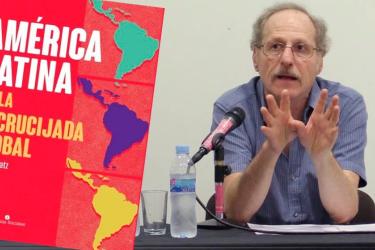
Latin America at the Crossroads. By Roberto Regalado. Translation by Peter Gellert. Ocean Press (www.oceanbooks.com.au), 2007, US$17.95; América latina entre siglos. Ocean Press, 2007, US$17.95.
This compact book by Roberto Regalado, a veteran member of the Central Committee of the Communist Party of Cuba, strongly reaffirms the need for revolution in Latin America and beyond.
Regalado, a section chief in the Cuban CP's Department of International Relations, is anything but dogmatic. He is attentive to recent new trends in Latin American economics and politics, and respectful toward the diverse currents of socialist opinion. He stresses the importance of the new features of Latin American social struggles: the role of peasants, the landless, indigenous peoples, women, environmentalists and others.


Recent comments
18 hours 44 min ago
19 hours 6 min ago
1 day 16 hours ago
2 days 6 hours ago
2 days 14 hours ago
2 days 14 hours ago
2 days 14 hours ago
2 days 14 hours ago
2 days 15 hours ago
2 days 17 hours ago